A collection of the rules and guidelines for Loot Items
¶ Item Loot Tier Tags
When making an item in the toolset, the following must be placed in the name field to colorize the item name.
+1 tier White (Enhanced) (No tag needed, reference only)
<c$þ$> +2 tier Green (Dweomered)
<c$þþ> +3 tier Light Blue (Enchanted)
<c¡IÍ> +4 tier Purple (Ensorcelled)
<cþ¡$> +5 tier Gold (Eldritch)
<cÕf°> +6 tier Pink (Ancient)
</c> Close tag ALWAYS CLOSE YOUR TAGS
So when you name the item and it's say a ... tier 4 put in the name field for the item <c¡IÍ>Ring</c> and it should work!
Color tier tags are REQUIRED for any item to be added to the loot pool.
Always copy/paste the colour tag. These are ASCII characters. (that
¡is not the letter ‘i’!)
¶ Item Loot Categories
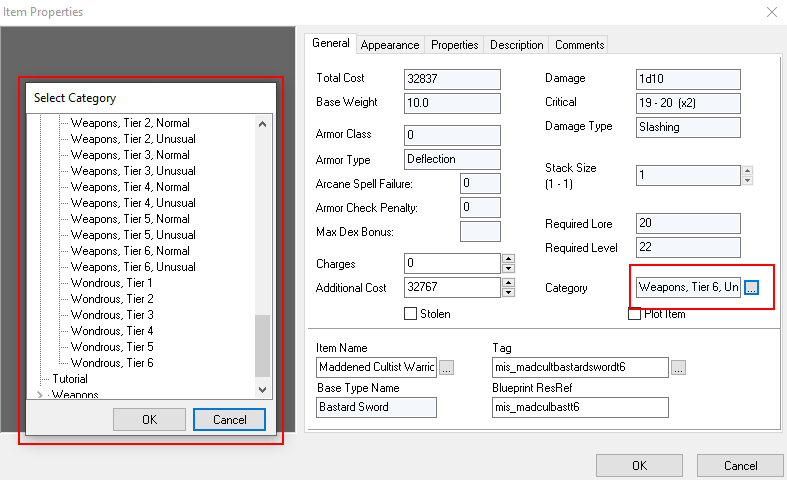
All loot items should have their categories set based upon their item type.
Weapon, Bows/Crossbow/Sling, Monk Gloves into Weapons, Tier 1-6, Normal or Unusual
Armor (Regardless of armor type) and Shield into Armor, Tier 1-6, Normal or Unusual
Amulet, Belt, Bracers/Gloves, Boots, Cloak, Helm, Ring, Staves/Off-hand Item into Wondrous, Tier 1-6
¶ Property Group Values & Limits
The following is designed to limit Item Property bloat on items and keep overall power in check. Each Property Group detailed below is given a point value. Base Item types are also given a Property Group Value Limit, which may not be exceeded. Each category is a property group, unless otherwise noted.
So for example, an AC bonus, Enhancement Bonus, or Keen are each one property group.
The Damage bonuses collectively on a weapon, or a bank of spell slots are each property groups that count once.
Each Ability Bonus entry is a property group. (For example, a single +3 to ability counts as ONE point. +1 to an ability ALSO counts as ONE point. Having +3 STR and +3 DEX is 2 property value points.)

Property Value Limits
| Item Type | T1-T4 | T5-T6 |
| Weapon | 5 | 6 |
| Bow/Crossbow/Sling (w/Unlimited Ammo) |
4 | 5 |
| Bow/Crossbow/Sling (No Unlimited Ammo) |
3 | 4 |
| Ammunition | 2 | 3 |
| Armor* | 5 | 6 |
| Shield | 4 | 5 |
| Amulet | 5 | 6 |
| Belt | 4 | 5 |
| Bracers/Gloves | 4 | 5 |
| Monk Gloves | 5 | 6 |
| Boots | 4 | 5 |
| Cloak | 4 | 5 |
| Helm | 4 | 5 |
| Ring | 3 | 4 |
| Staves/Off-Hand Item | 4 | 5 |
*: See Equippable Items Guidelines for specific exceptions regarding Special Armor Types for T4 rewards.
¶ Property Group Costs
| Property | Cost | Notes |
| Ability Bonus | 1 | 1 point per Ability Bonus; limit 2 per item. See guidelines for further information regarding limits for dual bonuses. |
| AC Bonus | 1 | Must Equal Tier. REQUIRED on Armor, Shields, Boots, and Amulets. |
| AC vs. Racial Group | 1 | Must Equal “Tier+1”. Limit 1 per item. Armors and Shields only. |
| Arcane Spell Failure Reduction | 1 |
Only allowed on Armor of Base AC 4/4 (Chain Mail) and below, AC 5/4 (Elven Chain). Only allowed on Tower Shields in T5 and T6. NOTE: AC 8/3 (Mithral Full Plate) not allowed -ASF on loot items. |
| Bane | 1 | T2 minimum, T3+ for full effect. See guidelines chart. |
| Damage Bonus vs (Non-bane) | 1 | Bonus Damage vs Specific Racial Type or Alignment. See below. |
| Bonus Feat | 1 | |
| Bonus Spell Slots | 2 | See guidelines chart for allowed extra slot amounts. |
| Cast Spell | 1 | See guidelines chart for allowed spell levels, spell amounts, uses per day, and charges and costs. |
| Damage | 1 | See guidelines chart for various values and rules. |
| Damage vs (Non-bane) | 1 | Bonus Damage vs Specific Racial Type or Alignment. See Weapon Guidelines. May NOT be stacked with bane. |
| Damage Reduction | 1 | Should not generally be used past T3. |
| Damage Resistance | 1 | If an item has both Physical and Elemental resists, it is only allowed one of each. Physical resists and Elemental resists are counted separately for costs. An item may have multiple elemental resistances for 1 point but at reduced values. See guidelines chart. |
| Enhancement Bonus | 1 | Must Equal Tier. |
| Extra Damage Type | 1 | Limit 1 per weapon. |
| Ghost Touch | 2 | |
| Avenger | 1 | Limited to T4 or Higher. May be used in place of Enhancement Bonus requirement. This property is only for Paladins or Blackguards. See Other Weapon Properties for full details. |
| Immunity: Specific Spell | 1 | Limited to 3rd-level spells and lower. |
| Keen | 1 | |
| Massive Criticals | 1 | T1-T3: up to weapon's base damage die; T4-T6: up to 2x weapon's base damage die |
| Mighty | 0/R | Must be equal to Tier x2 |
| Non-Detection | 2 | |
| Rapid Reload | 0/R | Crossbows only. |
| Regeneration | 1 | May be placed on Armor, Shield, Helmet, Amulet, Ring, and Weapon only; see detailed chart. |
| Saving Throw Bonus | 1 | See guidelines for details. |
| Sequencer | 2 | |
| Skill Bonuses | 1 | See guidelines for allowances and approval requirements. |
| Spell Resistance | 1 | |
| Unlimited Ammunition | 0 or NA | |
| Vampiric Regen | 1 | |
| Weapon On-Hit Effect | 1 |
¶ Disallowed Properties
- AC vs. Alignment Group or Specific Alignment
- Damage Bonus: Radiant, Necrotic, Vile, or Untyped
- Damage Resistance: Divine, Force, Hellfire, Magical, Necrotic, Positive, Psionic, Radiant, Untyped*, Vile
- Enhancement or Attack Bonus vs. Alignment Group
- Enhancement or Attack Bonus vs. Specific Alignment
- Freedom
- Haste
- Immunity: Damage Type
- Immunity: Miscellaneous
- Immunity: Spells by Level
- Immunity: Spell School
- Improved Evasion
- OnHit: Mords Disjunction, Slay (Alignment, Alignment Group, Racial Type)
- On Hit Cast Spell
- On Hits on Slot Items (non-weapons)
- Skill Bonus: UMD
- True Seeing
- Vorpal
¶ Weapon Guidelines
These rules are for LOOT ITEMS ONLY.
¶ Damage Limitations
Total MAXIMUM Damage Bonus by Tier for Loot Items
| Tier | 1-Hand | 2-Hand |
| 6 | 14 | 18 |
| 5 | 12 | 16 |
| 4 | 10 | 14 |
| 3 | 8 | 12 |
| 2 | 6 | 10 |
| 1 | 4 | 8 |
Flat Damage Bonus Limits per Tier:
Flat damage bonuses are those damage types that are not associated with a dice roll. For example, +4 fire or +2 electric. Multiple flat damage bonuses count towards the tier's limit. For instance, a Tier 5 can have two +2s, but not two +4s.
| Tier | Limit |
| 6 | +4 |
| 5 | +4 |
| 4 | +3 |
| 1-3 | +2 |
Damage Die Limits by Number of Different Damage Types:
Splitting damage types limits the maximum damage dice per type. The more types of damage on a weapon means each type uses smaller dice.
| 2 types | d8 |
| 3 types | d6 |
| 4 types | d4 |
Notes on Damage Bonuses:
- Tier 4: One damage type may have its damage dice increased by +2 for one-hand weapons, or +4 for a two-hand weapon.
- Tier 5 & Tier 6: One damage type may have its damage dice increased by +4 for one-hand weapons, or +6 for a two-hand weapon.
- Any damage die increase may not bypass the maximum damage limits for their tier. For example, a longsword may have 1d8 and +2 for a maximum +10 as Tier 4 loot.
- 'Rainbow' weapons may exceed the normal flat damage bonus limit per tier, but should only have 2 at most unresistible damage types. They cannot have higher die-based rolls, less they be forced to follow normal flat damage bonus rolls. Any one damage type may not exceed its listed value on the chart. Max damage should be lower than the tiers normal max damage limit, see the chart below.
Rainbow Flat Damage Limits & Max Value per damage Type:
| Tier | 1-Hand | 2-Hand | Max Value 1H | Max Value 2H |
| 6 | 10 | 12 | 3 | 4 |
| 5 | 8 | 11 | 3 | 3 |
| 4 | 7 | 9 | 2 | 3 |
| 3 | 5 | 8 | 2 | 2 |
| 2 | 4 | 7 | 1 | 1 |
| 1 | 2 | 5 | 1 | 1 |
Allowed or Disallowed Damage Bonuses
- Magical, Divine, Positive, damage should not be the primary damage type on items prior to Tier 4.
- Force, Hellfire, Psionic should not be on items prior to Tier 5.
- Items which only add these restricted damage types will require admin approval, as they bypass typical damage resistances in most dungeons.
- Radiant, Necrotic, Vile and Untyped* damage types cannot be added to any item.
Builder Notes:
- Adding the base damage type as physical damage - e.g. slashing on a scimitar, piercing on a dagger, bludgeoning on a mace - will NOT stack with the damage component of an Enhancement Bonus. It should be avoided.
- Creatures immune to Disease or Poison statuses have 100% Damage Immunity versus the respective Disease and Poison damage types.
Bonus Damage vs Specific Racial Type or Alignment:
If NOT a Bane Weapon, there may be an extra Racial Damage Bonus or Alignment Damage Bonus, limited by the weapon's base damage die. This bonus may cause the damage total to exceed the Weapon Damage Limit.
- May not have multiple instances to different types or races that could potentially overlap. Examples:
- +1d6 vs Undead and +1d6 to Construct are allowed.
- +1d6 vs Chaotic Evil and +1d6 Lawful Evil are allowed.
- But +1d6 vs Undead and +1d6 vs Chaotic Evil is NOT allowed.
- Multiple instances still cost 1 property point each.
- Damage vs. Evil(All Types) is not allowed outside the Avenger property.
¶ Monk Gloves
Monk gloves should have a tier appropriate Attack Bonus, and matching Bludgeoning Damage bonus. This bonus is exempt from the Maximum Bonus Damage (as it represents the damage component of the gloves' Enhancement); otherwise, the gloves are limited to the Maximum Bonus Damage limits listed above, treated as 2-handed weapons for damage value bonuses. Since Monk Gloves are also a bracer slot item, they may have non-weapon properties as detailed in the post below. Monk gloves may have a massive critical bonus property of 1d6 for gloves under tier 4, and 2d6 for tier 4/5/6.
¶ Fashion Accessories
Fashion Accessory 2-3(Fashion Accessory 1 does not function) are still considered Staves/Off-Hand Item for their points/costs, with the exception of the 'War Fan' options in Fashion Accessory 3. You may stat out any of the war fan models as a normal weapon, using the same stat lines a dagger would have(Accessories share the dagger feats)
¶ No Combat Damage
A weapon with this property may be given an additional Bonus Damage equal to the weapon's base damage dice. (For example, a longsword may have an additional 1d8 magical damage). This bonus damage is excluded from the Maximum Bonus Damage limits.
Builder Note: This property does not nullify Strength modifier damage, or the damage added due to Enhancement Bonuses. This property will also stop the extra damage from Overwhelming Critical feats.
¶ Unlimited Ammunition (Longbows, Crossbows and Slings)
Unlimited Ammunition is a free property and may be added to any bow, crossbow, or sling. Adding the Unlimited Ammunition property also increases the item's max property limit by +1. For example, a T6 longbow with the Unlimited Ammunition property will have a 5 property value limit instead of 4.
Required Properties
Unlimited Ammunition on Longbows, Crossbows and Slings must have a set Bonus Damage property according to the item's tier:
|
Item Tier |
Damage Bonus |
|
T6 |
2d6 |
|
T5 |
2d4 or 1d12 |
|
T4 |
1d8 |
| T3 | 1d6 |
| T2 | 1d4 |
Builder Note: The Enhancement to Damage value does not matter with any bow using Enhancement Bonus on the bow itself. It will display it as stacking, but the character sheet lies. Arrow bonus damage values should NOT be the same as any damage values on the bow itself.
¶ Other Weapon Properties
- Bane (vs. Racial Type): The Bane property adds +1 Enhancement Bonus over the Base Enhancement Bonus, and +2d6 Magical or Divine damage.(Should be magical for undead) These bonuses are vs a racial type and not vs. an alignment. Bane requires a base enhancement bonus of +3, and may not be put on a higher base than +6. No weapon should ever have an enhancement bonus higher than +7. The Bane bonus damage is exempt from the Maximum Damage Cap. Bane can NOT be mixed with Bonus Damage v. Specific Racial Type or Alignment.
- T2 Bane weapons may only have half the bonus damage for +1d6 magical or divine damage.
- Bonus Feat - Rapid Reload: Rapid Reload is a free property.
- Enhancement/Attack Bonus MUST equal weapon tier. The base/primary bonus should never exceed +6. All weapons except for Avenger are required to have this property.
- Ghost Touch: Limited to T4 or higher. Ghost Touch weapons bypass the concealment bonus on X2_L_IS_INCORPOREAL 1 variable-flagged NPCs.
- Avenger: Limited to T4 or higher and only for Paladins or Blackguards. Weapons with this property are exempt from the Enhancement Bonus requirement. Full Avenger Effect will apply to paladins of any level but only Blackguards of 10+ or more levels.
- MUST be class-locked to “Use Limitation: Paladin” OR “Use Limitation: Blackguard”, alignment-locked to “Use Limitation: Lawful Good” OR “Use Limitation: Evil”. Finally they must be set to both “Use Limitation: Must Meet All Requirements” AND “Use Limitation: No Use Magic Device”.
- Massive Critical: Should never exceed double the weapon's base damage die. For items under Tier 4, the massive critical should not exceed the weapon's base damage die. Monk gloves may have a massive critical bonus of 1d6 for items under Tier 4 and 2d6 for Tier 4/5/6.
- Mighty: Mighty is now a free property and may be added to Longbows, Crossbows, Slings, and Shuriken. Should be set to (and not exceed) x2 the weapon's Enhancement Bonus for all but Shuriken. Shuriken should be set to +20 Mighty.
- On Hit Properties: No more than 1 On-Hit property per weapon. DCs should be Tier Appropriate. Maximum DCs by tier are:
- T1: DC 16
- T2: DC 18
- T3: DC 20
- T4: DC 22
- T5: DC 24
- T6: DC 26
- Vampiric Regeneration:
- T1-T2: +1 Vampiric Regen regardless of weapon type.
- T3: +2 Vampiric Regen regardless of weapon type.
- T4-T5: +2 Vampiric Regen on a 1-handed weapon or +3 on 2-handed weapons.
- T6: +3 Vampiric Regen on 1-handed weapons or +4 on 2-handed weapons.
¶ Returning/Throwing Weapon Guidelines
The Returning item property converts ammunition and ranged throwing weapons into infinite stacks of ammunition and thrown weapons that never run out.
- Returning is only allowed on T3 and above.
- Returning Ammunition and Throwing Weapons need to be created with a stack size of 5000. Plan per item costs accordingly. Item stacks cannot be mechanically split.
- Throwing weapons otherwise follow the standard weapon guidelines.
¶ Returning Ammunition (Arrows, Bolts, Bullets)
Required Properties
Returning Ammunition uses its own item creation guidelines separate from weapon or equipped item guidelines:
- All Returning Ammunition must have a Piercing Bonus(Or Bludgeoning for Bullets) equal to the item tier level. Example T5 Arrows must have a +5 Piercing damage. This will not stack with Enhancement Bonus on a bow, and only applies for bows with only +AB. The character sheet will lie to you.
- All Returning Ammunition must have a set Bonus Damage property according to the item's tier:
|
Item Tier |
Damage Bonus |
|
T6 |
2d6 |
|
T5 |
2d4 or 1d12 |
|
T4 |
1d8 |
| T3 | 1d6 |
- T5 and T6 items may split the damage dice into two damage types at the cost of an additional property. For example, a T6 arrow may have a single 2d6 damage property, or two 1d6 damage properties.
Additional Properties
T3 and T4 Returning Ammunition cannot have any additional properties.
T5 and T6 Returning Ammunition can have a single additional property added from the following list:
- On-Hit
- On-Hit: Cast Spell (with admin approval)
- Vampiric Regeneration (Limited to +1 for T5 ammo, +2 for T6 ammo)
- Bane (vs. Racial Type): Add +1 Piercing Damage Bonus vs the selected racial type over the item's tier (ie. +5 ammo will be +6 vs racial type). Add +1d4 Divine or Magical damage versus the chosen racial type.
- Split the single set damage bonus in half to instead have two damage bonus properties. (T5 can have two 1d4 damage types, T6 can have two 1d6 damage types)
Builder Note: Returning Ammunition with On-Hit and On-Hit: Cast Spell properties will override both properties on the weapon, as well as Elemental Weapon. For example, an arrow/bolt/bullet with On-Hit: Stun will replace both On-Hit and On-Hit: Cast Spell properties from the used weapon, and any Elemental Weapon cast upon the weapon. These should generally not be used.
Extra Ranged Damage Type was previously allowed, but has been found to do absolutely nothing on arrows and should not be used.
¶ On Hit Properties & How They Work
Some On Hit: properties have hardcoded or hidden behavior. Here's a list of how each On Hit property works.
|
On Hit: Property |
Chance To Trigger / Duration |
DC |
Notes |
| Ability Drain | 50% Chance / Permanent | Configurable Will save vs. Negative |
Decreases the chosen ability by 1 on a failed save. As most common dungeon creatures are usually already dead before this can stack enough times to have any meaningful effect, and most high level bosses tend to be immune to ability drain, this property is not recommended. |
| Blindness | Configurable | Configurable Fortitude save |
A blind creature is unable to see. This gives them a 50% miss chance and a -4 penalty to all attack rolls, while giving those attacking them a +2 bonus to attack rolls. Furthermore, a blind creature is considered flat-footed and is subject to sneak attacks at all times even if not being flanked, and is unable to directly target distant creatures with spells or attacks. Additionally, there is a -4 penalty to discipline, hide, move silently, open lock, parry, pick pocket, set trap and tumble. Blind-Fight negates some of the effects of being blind, leaving only the -4 penalty to attack rolls, the -4 penalty to skills, and the inability to target creatures at a distance. A creature with true True Seeing granted via an item property, which almost all bosses and dragons have, negates all effects of blindness except for the 50% miss chance. |
| Confusion | Configurable | Configurable Will save vs. Mind Spells |
Every round, the affected creature has a chance of doing the following actions: 10% Chance: Randomly walk. 50% Chance: Do nothing. 40% Chance: Attack the nearest creature. As the nearest creature is often the attacking PC, and because trying to chase a randomly walking creature will provoke Attacks of Opportunity from nearby enemies against the player, this property is not recommended. If you want to create a weapon that CC's an enemy, use Hold or Stun instead. |
| Daze | Configurable | Configurable Fortitude save |
Dazed creatures cannot initiate attacks, cast spells, use skills, feats, or run. They can however walk and use items, including clarity potions which will clear the dazed effect. Depending on their AI package, a dazed NPC will either stand still, randomly walk, or attempt to walk to their nearest ally. Because trying to chase a walking creature will provoke Attacks of Opportunity from nearby enemies against the player, this property is not recommended. If you want to create a weapon that CC's an enemy, use Hold or Stun instead. |
| Deafness | Configurable | Configurable Fortitude save |
Deaf creatures suffer a 20% chance of spell failure when casting arcane spells with a verbal component, unless the spell is cast as a stilled spell (yes, Still Spell; blame Bioware) A deaf creature does not suffer any penalties to listen checks. As deafness prevents a creature from being affected by a bard's Curse Song and because its only mechanical use is to give 20% Spell Failure for verbal arcane spells to a enemy spellcaster, this property is not recommended as its uses are extremely niche and outdone by Taunt, and will make the owner the target of angry letters from every bard. |
| Disease | 50% Chance | nwn.fandom.com/wiki/Disease | This property is not recommended because of the long incubation times and low DCs of Diseases. |
| Dispel Magic | 50% Chance | Ignored | Dispel Magic is hardcoded to be cast at Caster Level 10. T3-T4 property. |
| Doom | Configurable | Configurable Will save |
Hardcoded list of effects: -2 attack rolls -2 physical damage -2 penalty to all skills -2 penalty to all saving throws |
| Fear | Configurable | Configurable Will save vs. Fear |
A feared creature will always attempt to run away in the opposite direction from the nearest enemy. Because trying to chase a running creature will provoke Attacks of Opportunity from nearby enemies against the player, this property is not recommended. |
| Greater Dispel | 50% Chance | Ignored | Greater Dispel is hardcoded to always be cast at Caster Level 15. Should never be on T4 or lower items. T5-T6 only. |
| Hold | Configurable | Configurable Will save |
A held creature will be paralyzed, acting as if they had 3 strength and dexterity and becoming flat-footed. Paralyzed NPCs with 4 or fewer hit dice are susceptible to a coup de grâce. |
| Knock | 100% Chance | Configurable | Knock is hardcoded to cast the Knock spell at a caster level of 1, if attacking a locked placeable or door with an open lock DC equal to or lower than this property's DC. As Knock has been changed to instead give a buff to Open Lock on the affected target, this property is mechanically dead and should not be given to anyone, ever. |
| Lesser Dispel | 50% Chance | Ignored | Lesser Dispel is hardcoded to be cast at Caster Level 5. T2 property. |
| Level Drain | 50% Chance / Permanent | Configurable Fortitude save vs. Negative |
Drains the affected creature with 1 negative level. As most common dungeon creatures are usually already dead before this can stack enough times to have any meaningful effect, and most high level bosses tend to be immune to level drain, this property is not recommended. |
| Mordenkainens Disjunction | 50% Chance | Ignored | Mordenkainen's Disjunction is hardcoded to always cast at Caster Level 20. This property is restricted and can only be given to NPCs. This is never allowed on any loot items, EVER. |
| Poison | 50% Chance | Configurable Fortitude save vs. Poison |
The affected creature's ability score is decreased by 1d2. As most common dungeon creatures are usually already dead before this can stack enough times to have any meaningful effect, and most high level bosses tend to be immune to ability drain or poison, this property is not recommended. |
| Silence | Configurable | Configurable Will save |
A silenced creature make no noise while moving (opposed listen checks automatically fail), and silenced spellcasters will be unable to cast spells with verbal components. On Hit: Silence has been modified here to not block bard song or curse song. |
| Slay Alignment | 50% Chance | Configurable Fortitude save vs. Death |
The creature is struck dead. This ignores death magic immunity. This property is restricted and can only be given to NPCs. This is never allowed on any loot items, EVER. |
| Slay Alignment Group | 50% Chance | Configurable Fortitude save vs. Death |
The creature is struck dead. This ignores death magic immunity. This property is restricted and can only be given to NPCs. This is never allowed on any loot items, EVER. |
| Slay Racial Group | 50% Chance | Configurable Fortitude save vs. Death |
The creature is struck dead. This ignores death magic immunity. This property is restricted and can only be given to NPCs. This is never allowed on any loot items, EVER. |
| Sleep | Configurable | Configurable Will save vs. Mind Spells |
Creatures who are sleeping are considered flat-footed. Creatures damaged while sleeping will wake up. A sleeping NPC with 4 or fewer hit dice is susceptible to a coup de grâce. As sleeping creatures are awoken by any damage taken, this property is not recommended. |
| Slow | Configurable | Configurable Will save |
Affected creatures are slowed, suffering a -2 penalty to AC and attack rolls, -50% movement speed penalty, and are limited to only one attack per round. Haste will counter the effects of slow; however, if that creature is then slowed a second time they will be slowed, and cannot counter it with another haste until their first haste expires. |
| Stun | Configurable | Configurable Will save vs. Mind Spells |
The affected creature will be stunned and become flat-footed. Attacking creatures gain a +2 bonus to their attack rolls against stunned creatures. Immunity to mind-affecting spells will block stun. Comparatively to On-Hit: Hold, On-Hit: Stun cannot be blocked by anything that grants immunity to paralysis such as Freedom of Movement, and with the +2 bonus to attack rolls for attackers, stunned creatures are at a greater disadvantage to being hit. |
| Vorpal | 100% Chance on a confirmed Critical Hit | Configurable Reflex save |
The struck creature makes a reflex save, or dies. This property is restricted and can only be given to NPCs. This is never allowed on any loot items, EVER. |
| Wounding | 100% Chance when physical damage is dealt | Configurable Fortitude save |
The affected creature loses 1 hit point per round. Wounding can stack with itself. Because any amount of physical damage resistance or reduction will negate the 1 point of damage from wounding, and because any amount of healing (not including regeneration) removes it, this property it not recommended. |
¶ Equippable Item Guidelines
These rules are for DM ITEMS ONLY. Loot items have their own separate rules.
Unique Armor Types: Mithril & Adamantine
Mithril Fullplate, Adamantine Fullplate and Elven Chain armors are limited to Tier 4 or higher.
- Mithril Fullplate, Adamantine Fullplate: Tier 4 - These armors should be plain, with no additional properties
- Elven Chain: T4 - Follow the same guidelines as regular armor of each tier.
- Tier 5 & 6 - These armors should follow the same guidelines as regular armor of each tier.
¶ Ability Points
Ability Bonuses are limited to +1 per Item Tier per ability. No more that 2 Ability Bonuses per item. (Costs 2 points if two bonuses are used.)
Two Ability Bonuses on an item:
T1: Limited to one ability bonus only.
T2-T5: If an item has 2 ability bonuses, then the bonuses are limited to the tier -1
A T2 item could have +1/+1 bonuses, but not +2/+2.
A T4 item could have +3/+3 bonuses, but not +4/+4.
T6: May have the full +6/+6.
AC Bonus
AC Bonuses are limited to +1 per Tier, to the cap of +6. AC bonuses are required on armor, shields, boots, and amulets. These bonuses should equal the the tier level of the item.
AC Bonus vs. Racial Group:
AC Bonus vs. Racial Group may be +1 over the item's tier level.
- Limited to armors and shields only
- Only 1 racial type per item
Arcane Spell Failure Property
Reduced Arcane Spell Failure is only valid on Armor or Shields. This property is limited as follows:
- May not be used on armor over base AC 4 (chain shirt), EXCEPT for AC 5/5 Elven Chain.
- Only allowed on Tower Shields as Tier 5 and Tier 6 items. Allowed on other shields as normal.
Bonus Feat
Requires Admin Approval.
- Approved Bonus Feats: Blackguard Sneak Attack +1d6, Cleave, Dodge, Extra Turning, Rapid Reload*
- Any other feats on old items(Or items with more than one feat, for example, Blinding Strike bracers) are grandfathered in and should not be taken as permission for future items.
*(This should be on all crossbows and not on anything else)
¶ Bonus Spell Slots
Item rewards should not include slots above what they can currently cast/access. Bonus spell slots are limited by tier and by class, with a maximum number of spell slots.
Maximum Number of Bonus Spell Slots:
| Item Tier |
Assassin Blackguard Paladin Ranger |
Bard Cleric/Favored Soul Druid Sorcerer/Wizard |
| T6 | 4 | 5 |
| T5 | 3 | 5** |
| T1 - T4 | 2 | 4 |
**: T5 items are limited to one 9th level spell slot for full casters.
Maximum Spell Slot Level:
| Item Tier |
Assassin Blackguard Paladin Ranger |
Bard | Cleric/Favored Soul Druid Sorcerer/Wizard |
| T5 & T6 | 4 | 6 | 9 |
| T4 | 3 | 4 | 6 |
| T3 | 2 | 3 | 4 |
| T2 | 1 | 2 | 3 |
| T1 | 0 | 1 | 1 |
Mystic Theurges items may have their bonus spell slots split between their classes. For example, a tier-5 item may have wizard 7/8/9 and cleric 7/8.
Swordmage Spell Slots are not allowed on Loot Items.
Cast Spell Property
Spell Level Limit: Magic staves & off-hand items (excluding shields or weapons) are limited to 6th level spells or lower. All other items are limited to 5th level spells or lower.
Number of Cast Spells: Tier 4 and lower items are limited to 2 cast spells per item. Tier 5 and Tier 6 items are limited to 3 cast spells per item.
- If all of the Cast Spells on an item use charges rather than per day uses, then this limit is equal to the item's tier minus 1. (For example, a Tier 5 item could have 4 cast spells on it if they all use charges.)
Disallowed Cast Spell Properties:
The following are not allowed on loot items, no matter their level.
- Deafening Clang, Caustic Edge, Spikes, Moonblade, Shadow Double
Cast Spell: Any Ioun Stone effects
If an item has a Ioun Stone effect, then the that counts as the entirety of that items Cast Spell limit. No other spells, day or charges are allowed. Must be limited to a maximum of 50 charges, at 1 charge per use.
Chaos Shield
This property is limited to Shields. Caster Level of Chaos Shield is limited to 5 or lower.
¶ Damage Resistances
Damage Resistance - Physical
Individual Resistance Amount Limits:
| Item Tier | Limit |
| T6 | 10/- |
| T3 - T5 | 5/- |
| T1 & T2 | None |
Physical Resistance Type Limits:
| Item Tier | Armor | Shield | Other Items |
| T6 | 3 types | 3 types | 1 type |
| T5 | 2 types | 3 types | 1 type |
| T3 & T4 | 1 type | 2 types | 1 type |
Damage Resistance - Elemental (Acid, Cold, Disease, Electric, Fire, Negative, Poison, Sonic)
Maximum Resistance per Element:
| T6 | 25 |
| T5 | 20 |
| T4 | 15 |
| T3 | 10 |
| T1 & T2 | None |
Elemental Resistance Types Limits:
Elemental resistances are limited in the number of elements per item based on the amount of the resistance.
This is combined with the above maximum resistance per element.
T6 items may have 1 element at 25/-, or 2 elements at 15/-, or 3 elements at 10/-.
T5 items may have 1 element at 20/-, or 2 elements at 15/-, or 3 elements at 10/-.
T4 items may have 1 element at 15/-, or two 10/-.
T3 items may have 1 element at 10/-, or two at 5/-.
T1-T2 items may not have elemental resistances, unless it is the only property on the item beyond AC.
In such a case, T1 items should be 5/-, T2 10/-, T3 15/-.
All of these examples cost 1 point of their ‘buy’.
| Amount of Resistance | Maximum # of Elements |
| 20/- and higher | 1 element |
| 15/- | 2 elements |
| 10/- | 3 elements |
Prohibited Resistance Types: Divine, Force, Hellfire, Magical, Necrotic, Positive, Psionic, Radiant, Untyped*, Vile.
Limited Resistance Types: Psionic, Hellfire - At MAXIMUM these are allowed 10/- at T6. They should not be present on T4 or below. T5 may have 5/- maximum.
This should be removed or if want to add any other types (but limited) can.
Damage Reduction Limits
T3: 10/+2
T1-T2: 10/+1
Damage Reduction generally shouldn't be used past T3.
Immunity: Specific Spell Property
Items should have no more than 1 spell immunity, limited to 3rd level spells or lower.
Note, spells that do not check SR will not actually work for this, even if they can be selected in the toolset
Non-Detection
Non-Detection is added to an item by adding both Immunity: Miscellaneous Scry and Detect Alignment.
¶ Regeneration
Regeneration is limited to the following listed item types. If the item type isn't listed, it should not have regen on it.
The amount of regen allowed per item:
| Item Type | Tier 6 | Tier 5 | Tier 4 | Tier 3 and lower |
| Armor | 2 | 2 | 1 | 1 |
| Shield | 2 | 2 | 1 | 1 |
| Helmet | 2 | 2 | 1 | 1 |
| Amulet | 2 | 2 | 2 | 1 |
| Ring | 2 | 2 | 2 | 1 |
| Weapon | 1 | 1 | 1 | 1 |
¶ Saving Throw Bonuses
Items may either include bonuses to Universal Saving Throws, or bonuses to 2 specific types of saving throws.
- Bonuses to Universal Saving Throws are limited to +1 per tier. (For example, a T5 item may have up to +5 Universal Saving Throws.)
- Bonuses to specific saving throws are limited to +1 per tier +2. (For example, a T5 item may have up to +7 bonus to saves vs. mind affecting.)
¶ Skill Point Bonuses
Skill bonuses are limited by tier, amount per skill, and total number of Skill Points on the item as shown on the chart below.
- Bonuses to UMD are not allowed.
- Knowledge: Netheril bonuses are limited to half the "per skill limit" bonus. For example, a T4 item has a maximum Knowledge: Netheril bonus of +6. These ranks count as double toward the total skill point limit.
- This property may be put on an item twice with Admin approval, doubling the allowed total skill limit and doubling the individual skill limit. For example, a T6 item would have a total point limit of 68 and a per skill limit of 30.
| Normal Values | Doubled Values | |||||
| Item Tier | Per-Skill Limit | Total Point Limit | Item Tier | Per-Skill Limit | Total Point Limit | |
| T6 | 15 | 34 | T6 | 30 | 68 | |
| T5 | 12 | 28 | T5 | 24 | 56 | |
| T4 | 9 | 22 | T4 | 18 | 44 | |
| T3 | 6 | 16 | T3 | 12 | 32 | |
| T2 | 4 | 10 | T2 | 8 | 20 | |
| T1 | 4 | 6 | T1 | 8 | 12 | |
Sequencer Property
The Spell Sequencer property is limited to Tier 5 items and higher. These spells are limited to 1/day. The item must have Cast Spell: Clear Sequencer with unlimited uses/day. The number of spells allowed on a sequencer item is limited by item tier.
- Tier 6 - 2 spells 1/day
- Tier 5 - 1 spells 1/day
¶ Spell Resistance Property
Spell resistance is limited by the item's tier level:
- Tier 6 - +34
- Tier 5 - +30
- Tier 4 - +26
- Tier 3 - +22
- Tier 2 - +18
- Tier 1 - +14
¶ Advice: How To Write Item Descriptions
(Courtesy: Nokteronoth)
Item descriptions are one of those things that seems like it should be easy and simple. For some people, it is. For some, it isn't. It can be a very time intensive process, depending on how detailed you want to get with your items. All items that are given out by DMs should have a description that scribes out the item's history, its looks, and other details that are pertinent to the item's powers. Some things can be handwaved away by 'It's magic, it works.' Others, it's good to spell out.
Why are item descriptions important? On top of items having a slightly-increased property count and power over normal loot items, items are rewards for plotlines. For small trinkets and one-shot charge-use items, the description is much less important. However, it's still key to the longevity and 'worth' of an item, to players. Some items will stay with a character for years, and you should want the item's quality to reflect the effort and time it took in both running the plot and the growth of the characters in that plot.
Note that some players will claim to be happy with whatever you give them, even if they're actually disappointed or don't like a thing. They might hold it in that some properties aren't to their taste, or that they appreciate the effort put into an item. However, they'll often then talk to their friends, compare items with others, and either subtly or not-subtly let others know that they aren't happy when you aren't around. It's best to try to maintain an atmosphere of being able and willing to work with a player and character to make an item that they will treasure.
There are several parts to the general description of an item. Some of these may be eschewed or skipped over, if others are being met. All DMs will have their own style of writing, and may put these things in different order. This is NOT a suggested list of 'how it should be done', but a sounding board where you can use these points to find inspiration for your items.
- The Name of an Item: Every item name should be unique. They can be a joke or a pun, following alliteration through consonance or assonance, but every item should be unique and different from one another. Some DMs like to follow the PnP guidelines of using a suffix and a prefix for an item - A cold-forged iron blade of smiting. Others like to connect their items' names to the history of that item. Yet more like to use a bit of wordplay and always have similar words, like the 'Blackened Bastard-Sword of Blamaux', as an example. If your item names end up something similar to another DM's, that's perfectly fine. It is good practice, however, to make sure items from a single plot tend to be varied as players will show their items to one another and you should strive for each to be unique and special.
- The History of an Item: A given item has an origin and where it came from. For some events, items may be made at the end of it specifically for a person. For others, they might find a thing that's ages old and has a long and varied past. Either way, a DM can describe where the item came to be and how. Was it forged in some special place with RP significance? Did the materials that make it come from a particular place or time in history? If it was made for that plot, did the forger put some of the plot into the item? Give the player something to remember about their item, and they can talk about it to others in-character.
- The Materials and Look of an Item: All items are made up of something, whether it's adamantine or wood or magic or gems or whatever else. You can make an item as cheap or as gloriously expensive as you want for purposes of a plot. This means that you can also describe the look and feel of an item. Is it smooth? Is it shiny? Is it matte? Is it heavy, or cold, or hot? Does it have a certain scent? Is it dinged up from its history? Pristine? Remember your senses, just like you use with area descriptions and otherwise. In the case of most items, this has to do with vision, touch, scent, and the like. Typically taste is excluded… unless dealing with Spoofini creations. (Be encouraged to echo or support these descriptions with matching “Material:” properties!)
- The Plot Significance of an Item: Presumably, a player has gone through a plot to get an item. Why is that item connected to the plot? How did it get to the character? Did they retrieve or find it somewhere? Did they make it themselves? Did a NPC give it to them? It can be good to go through not just the history of the item, but why they now have it. This can help remind the player of the plot they were in even years down the like from the finale. Even small tidbits as a reminder about the plot can give them a full memory of it and give them something to talk about in the future.
- Personalize Each Item if Not a Trinket: Small things can be generally left generic, like a token or a treat or a bottle of wine. These things are not made items specifically forged and crafted for characters. However, items that are made for characters and adventurers should be personalized to them. Include their name. Include a bit of their part of the quest. Include a bit of who they are. This can be written in with the plot significance relatively easily (Character was given X for Y reason), but it's still important to note. Remind a player what their character was doing to get this item and their specific part of the quest. Why should it be important to them? Why is it special for them and not just given to someone else?
- The Magic of an Item: Finally, a very important part of the item lies in how it works. This may seem simple, but it can be a place to get incredibly creative with your writing. If an item is holy, does it have a holy symbol on it? Is that symbol incorporated into the magic of the item? If an item is magical, does it have runes somewhere? Can those runes be read? What does it look like when the item is used? What does it feel like to the wielder? Do they have to say or do something to activate the power of said item? You can get creative with this facet of an item's existence by putting certain things that aren't represented in game, but can be RPed. Flames shoot up a blade from a gem on the hilt a la 'Curoch' from the Brent Weeks books, or a pair of red ruby slippers with Teleport don't work until you click the heels together three times.
The description of an item doesn't have to be exhaustively long, especially for events where you're making a lot of items. However, a little care and customizability can go a long way to making your items memorable. Things to avoid:
- Try not to be generic with your items. If it's the same as loot, then why are you giving it out? If it's a plain-looking longbow, why does an adventurer want to keep it over a beautiful runed elven bow they found in a chest?
- Do not use a template for every single item. The general layout and facets of the item descriptions can be similar, but don't use the same wording or phrases for each item. Even if they're from the same source and history, try to rewrite each even if it's just in word order. Players will compare, and items seem far less special when they're all incredibly similar to one another.
- Do not use a description that would be against a character's being. If you've got a paladin on a quest, even if the player doesn't request a non-evil item, try to foresee what the character would keep as a treasure or not. A druid might highly prefer armor made of ironwood he doesn't have to change himself. A dwarven weapon master might prefer a old clansman's axe over a captured orcish warchief's, et cetera.
- Try to keep class buffs and other considerations in mind. This gets harder by far with larger numbers of items, but can be very important. Most players won't give an exhaustive list of properties or what they don't really want on an item - The list is huge! However, it can go a long way to making sure people are happy with their gear. Don't give charge/day items that a character can cast themselves. Don't make an item extra weight if the character is low-STR (Though it could be a fun RP cookie for stronger heroes!). Things like adding piercing damage to a Druid's weapon can be counterintuitive to them using Spikes, or sonic damage to a Paladin's.
If you need help finding inspiration or want a second pair of eyes on item descriptions, the rest of the DM team is there to help! Most all of us keep logs and records of what we make. These descriptions can be shared and traded around to give you an idea of what you might like to do with given item rewards.